Friday, 3 July 2026

Friday, 3 July 2026
The FTA will eliminate or reduce tariffs on 95 per cent of New Zealand’s exports to India, one of the most comprehensive outcomes in any Indian trade deal India and…
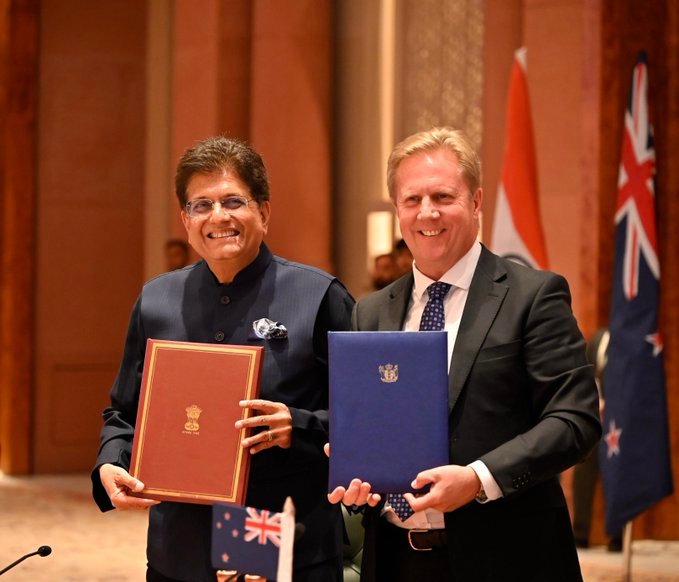
The FTA will eliminate or reduce tariffs on 95 per cent of New Zealand’s exports to India, one of the most comprehensive outcomes in any Indian trade deal
India and New Zealand have signed a historic Free Trade Agreement (FTA), marking a major milestone in bilateral economic relations and opening new avenues for trade, investment, and job creation in both countries.
The agreement was signed in New Delhi by Piyush Goyal and Todd McClay in the presence of Christopher Luxon, alongside business leaders from both nations.
Described as a “once-in-a-generation” deal by New Zealand leadership, the FTA is expected to significantly expand trade ties between the two economies. Bilateral trade currently stands at NZ$3.95 billion, with projections indicating substantial growth following the agreement’s implementation.
The FTA will eliminate or reduce tariffs on 95 per cent of New Zealand’s exports to India, one of the most comprehensive outcomes in any Indian trade deal. Approximately 57 per cent of exports will become duty-free immediately, increasing to 82 per cent over time.
Key sectors benefiting from tariff reductions include:
Agriculture: duty-free access for sheep meat, wool, and a range of horticultural products
Seafood: phased tariff elimination over seven years for products such as mussels and salmon
Industrial goods: reduced tariffs on iron, steel, and aluminium over a decade
Dairy: improved access for infant formula and specialised dairy products
Tariffs on wine, currently as high as 150 per cent, will be reduced significantly over 10 years, while mānuka honey duties will fall sharply from 66 per cent to 16.5 per cent within five years.
According to Prime Minister Luxon, the agreement will help generate jobs and boost incomes in New Zealand, where one in four jobs is linked to trade. Trade Minister McClay added that the deal supports New Zealand’s ambition to double export value within a decade.
For India, the FTA aligns with its broader strategy to deepen engagement with developed economies and expand global trade partnerships.
Highlighting the significance of the agreement, Piyush Goyal said, “The India–New Zealand Free Trade Agreement marks a defining milestone in India’s engagement with the developed world. It reflects Prime Minister Narendra Modi’s vision of global economic partnerships for our farmers, women, youth, artisans and entrepreneurs.”
He added that the agreement focuses on empowering exports, boosting agricultural productivity, enhancing student mobility and skills, and strengthening investment and services. Goyal also emphasised the expected US$20 billion investment inflows and noted that the deal places special emphasis on MSMEs, innovation, and women-led enterprises.
A notable feature of the agreement is the inclusion of Most Favoured Nation (MFN) provisions, ensuring that New Zealand gains access to favourable terms granted to other trading partners, particularly in services and wine exports.
The deal also emphasises:
Support for MSMEs and women-led enterprises
Enhanced mobility for students and skilled professionals
Greater collaboration in technology and innovation
Following the signing, the agreement will undergo parliamentary scrutiny in New Zealand before coming into force. Once implemented, it is expected to deliver long-term economic benefits and strengthen strategic ties between the two nations.
The India–New Zealand FTA adds to India’s growing portfolio of trade agreements with advanced economies, further integrating it into global trade networks and reinforcing its position as a major economic powerhouse.

Jul 03, 2026 | Beverages

Jul 01, 2026 | Food Security

Jul 01, 2026 | Food Safety and Testing
Jul 01, 2026 | Food Safety and Testing

Jun 18, 2026 | Company News
Jul 03, 2026 | Dietary Supplements
Jul 03, 2026 | Company News
Jul 03, 2026 | Beverages