Friday, 3 July 2026

Friday, 3 July 2026
Dr Francisco Trujillo, Researcher at the University of New South Wales Coffee has long been defined by one essential rule: great espresso requires heat. Researchers at the University of New…
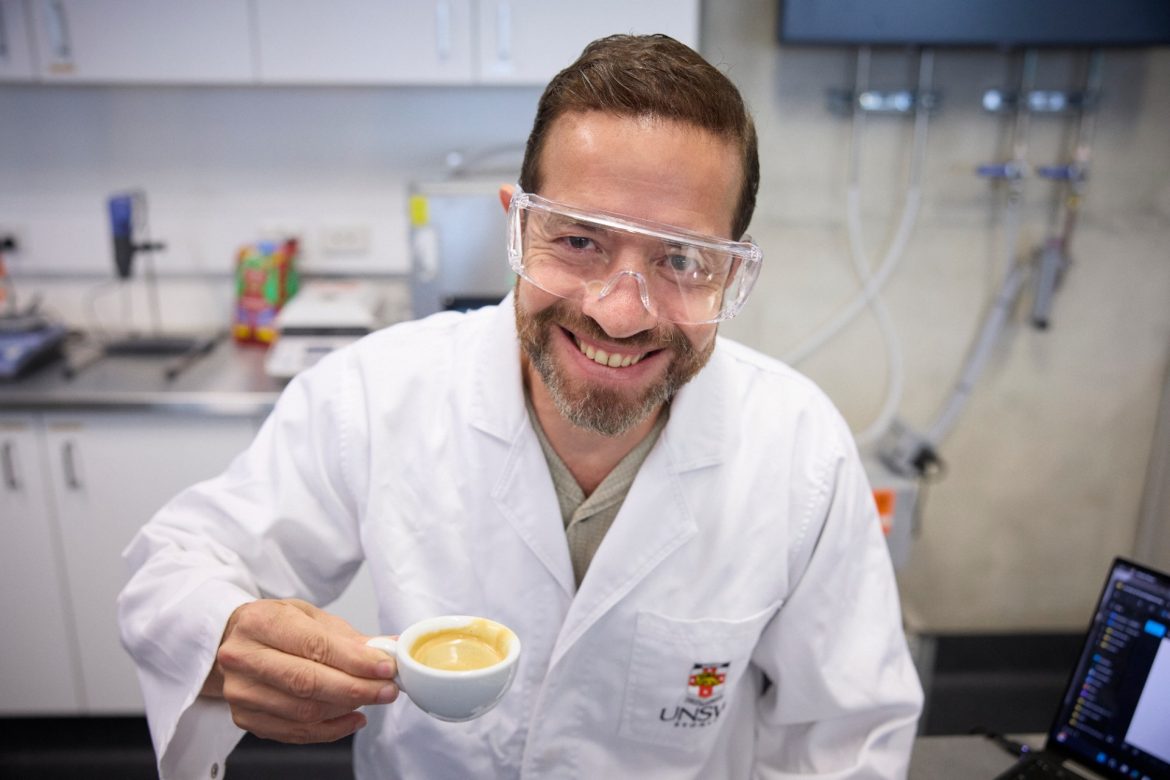
Dr Francisco Trujillo, Researcher at the University of New South Wales
Coffee has long been defined by one essential rule: great espresso requires heat. Researchers at the University of New South Wales are now challenging that assumption with an innovative ultrasound-assisted brewing technology that produces espresso-style coffee at room temperature while reducing energy consumption by around 75 per cent.
Developed by a research team led by Dr Francisco Trujillo, the prototype uses ultrasonic energy to accelerate coffee extraction, delivering espresso-like strength, caffeine concentration and flavour without the need for high-temperature brewing. The breakthrough could have far-reaching implications not only for coffee preparation but also for the ready-to-drink beverage industry, where energy efficiency, product consistency and sustainable manufacturing are becoming increasingly important.
In this exclusive interview with NUFFOODS Spectrum, Dr Francisco Trujillo discusses the science behind ultrasound-assisted coffee extraction, the engineering challenges of recreating traditional espresso without heat, the encouraging results from blind consumer taste tests, and the technology’s potential applications beyond coffee, from tea and plant-based beverages to nutraceuticals. He also shares his vision for scaling the innovation from a laboratory prototype to commercial production.
What were the biggest scientific and engineering challenges in achieving a flavour profile and caffeine concentration comparable to traditional espresso?
The biggest challenge was that espresso is normally produced through a very specific combination of hot water, pressure, fine coffee grounds and rapid extraction. Heat plays a major role in accelerating the extraction of soluble compounds, oils, aroma compounds and caffeine. Our challenge was to achieve similar extraction at much lower temperature, without relying on the thermal energy normally used in espresso brewing.
From an engineering perspective, the key challenge was not simply “adding ultrasound” to coffee. We needed to deliver ultrasonic energy efficiently and directly into the coffee bed. To do that, we redesigned the ultrasonic horn and filter basket system so the basket itself behaves like a resonant ultrasonic reactor. This creates multiple cavitation zones inside the coffee bed, helping accelerate extraction at room temperature.
We then had to tune several brewing parameters — including grind size, brew ratio, ultrasound power and extraction time — to reach espresso-like strength, caffeine concentration and sensory performance. The result was an ultrasonic espresso-style coffee that could reach comparable concentration and caffeine levels in around two to three minutes.
Could you elaborate on how the 75 per cent energy savings were calculated and their implications for the coffee and ready-to-drink beverage industries?
The energy saving was measured by comparing the energy consumed by the ultrasonic brewing system with a conventional espresso machine under matched beverage-strength conditions. In the study, both systems were used to prepare three espresso-strength beverages over a defined 20-minute operating period. The ultrasonic system consumed only about 24.3% of the operational energy used by the conventional espresso machine, which corresponds to an energy reduction of approximately 75 per cent.
The main reason is that conventional espresso machines require energy to heat water and maintain hot metal components at elevated temperatures. In contrast, our process uses ultrasonic energy to accelerate extraction at room temperature, so it largely avoids the energy demand associated with heating.
For the coffee and ready-to-drink industries, this could be significant. Industrial coffee production often involves large volumes, long processing times and substantial energy use. If this technology is scaled successfully, it could help producers make concentrated coffee extracts more quickly and with lower energy demand, especially for ready-to-drink coffee, cold brew, milk-based coffee beverages and coffee concentrates.
Does ultrasound-assisted brewing offer advantages in extraction yield, consistency, or preservation of flavour compounds compared with conventional methods?
Yes, ultrasound-assisted brewing showed clear advantages in extraction yield under low-temperature conditions. Without ultrasound, room-temperature brewing under the same conditions could not achieve the same espresso-strength extraction. With ultrasound, we were able to reach total dissolved solids and extraction yields within the range associated with traditional espresso.
There is also a potential consistency advantage. Traditional espresso is very sensitive to variables such as tamping force, grind size, puck density, flow rate and operator technique. Our ultrasonic process uses a freely packed coffee bed without tamping, which may reduce some of the variability associated with conventional espresso preparation.
In terms of flavour compounds, the study found no statistically significant overall differences in key physicochemical markers or volatile aroma composition between ultrasonic and conventional espresso under the tested conditions. That suggests the process can accelerate extraction without substantially disrupting the flavour profile. For filter-style coffee, the ultrasound-brewed version was actually preferred by consumers, particularly in relation to bitterness.
What were the key findings from your blind taste tests regarding consumer perception?
The sensory results were very encouraging. Around 100 regular coffee consumers took part in a blind sensory test. They evaluated traditional espresso, ultrasound-brewed espresso, traditional filter coffee and ultrasound-brewed filter coffee.
For espresso, consumers showed no significant preference between the traditional and ultrasound-brewed versions across key attributes such as aroma, flavour, bitterness and overall liking. In practical terms, most participants could not reliably distinguish the ultrasonic espresso from the conventional espresso under the test conditions.
For filter coffee, the results were even more interesting. The ultrasound-brewed filter coffee was significantly preferred over the conventional pour-over version, with participants rating its bitterness more favourably. This suggests ultrasound may not only preserve consumer acceptance but, in some brewing styles, may improve the sensory experience.
How scalable is this system, and are you currently working with industry partners for large-scale production?
The system was developed as a prototype, but the underlying principle is highly relevant to scale-up. The process works by coupling ultrasonic energy directly into the coffee bed during controlled water percolation. That means it could potentially be scaled by increasing reactor capacity, using multiple ultrasonic modules in parallel, or adapting the system for continuous industrial extraction.
The most immediate opportunity may be in large-scale production of coffee concentrates and ready-to-drink beverages, where companies need speed, consistency and energy efficiency. Because the process can produce concentrated coffee with espresso-like strength, it could be used directly in ready-to-drink products or diluted later into different beverage formats.
At this stage, the next step is to work with industry partners to validate the technology at larger scales and in real production environments. We are particularly interested in collaborations with coffee beverage manufacturers, ready-to-drink producers and coffee machine or extraction-equipment companies.
Do you see this technology being applied to other categories, such as tea, plant-based beverages, or nutraceutical products?
Yes, there is strong potential beyond coffee. Ultrasound is very effective at enhancing mass transfer, which means it can help extract flavour compounds, bioactive compounds, aromas and soluble materials from plant-based ingredients.
That could make the technology relevant to tea, botanical infusions, plant-based beverages and nutraceutical extracts, especially where low-temperature processing is desirable. Low-temperature extraction can be valuable when manufacturers want to reduce energy use, shorten processing time or protect heat-sensitive compounds.
However, each product category would need its own optimisation. Coffee was the focus of this study, so applications in tea, plant-based beverages or nutraceuticals would require dedicated research to determine the best ultrasound conditions, extraction time, ingredient preparation and product quality outcomes.
What are the next steps for this research before the technology becomes commercially available?
The next steps are scale-up, engineering refinement and industry validation. We have shown that the system can produce espresso-strength coffee at low temperature with much lower energy use and strong consumer acceptance. Now the focus is on making the technology robust, repeatable and suitable for commercial environments.
For domestic or café applications, that means refining the prototype into an automatic machine that is easy to use, safe, reliable and compatible with normal coffee workflows. For industrial applications, it means testing larger systems, validating throughput, energy savings, cleaning requirements, product consistency and long-term operation.
We also want to continue sensory and chemical evaluation across different coffee origins, roast profiles and beverage formats. Commercialisation will depend on the right partnerships with manufacturers and beverage companies that can help take the technology from prototype to market-ready product.
Shraddha Warde
shraddha.warde@mmactiv.com
Jul 03, 2026 | Beverages

Jul 01, 2026 | Food Security

Jul 01, 2026 | Food Safety and Testing
Jul 01, 2026 | Food Safety and Testing
Jun 18, 2026 | Company News
Jul 03, 2026 | Beverages
Jul 03, 2026 | Company News
Jul 03, 2026 | Europe