Thursday, 9 July 2026

Thursday, 9 July 2026
The project was led by eSAT Global, with Smart Paddock providing on-farm visualisation and Viasat delivering satellite connectivity Meat & Livestock Australia (MLA) announced the successful completion of an MLA…
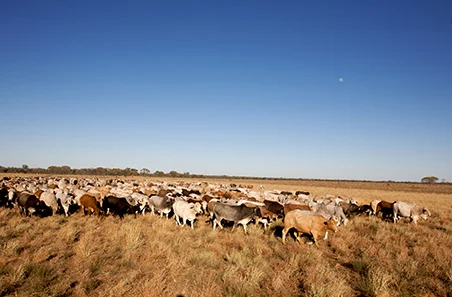
The project was led by eSAT Global, with Smart Paddock providing on-farm visualisation and Viasat delivering satellite connectivity
Meat & Livestock Australia (MLA) announced the successful completion of an MLA Donor Company (MDC) AgTech project that has demonstrated reliable and affordable two-way satellite connectivity for livestock and on-farm Internet of Things (IoT) sensors across Australia.
The project was led by eSAT Global, with Smart Paddock providing on-farm visualisation and Viasat delivering satellite connectivity.
Trials conducted in June 2025 at Pinjarra Hills in Queensland and Rockhampton in Central Queensland confirmed the technology’s ability to deliver high message success rates using low power and low bandwidth while maintaining two-way connectivity, increasing efficiency and reliability.
These results demonstrate strong potential for cost-effective whole of herd tagging and remote monitoring of assets such as water troughs and soil moisture probes, supporting pricing targets that make per animal connectivity practical for producers.
MLA Group Manager for Science and Innovation, Michael Lee, said connectivity remains one of the biggest barriers to widespread digital adoption across extensive grazing systems.
“For many, connectivity has been the missing link for broad adoption of digital tools in extensive grazing systems,” Lee said.
“With this project, the team have shown the potential for producers to achieve reliable, two-way satellite data at a cost that stacks up, supporting better grazing decisions, earlier health interventions and stronger traceability.”
SAT Global CEO, Rick Somerton, said the project validated the company’s purpose-built geostationary satellite technology, designed for tiny data packets, ultra-low power use and rapid message delivery.
“Our GEO satellite approach is purpose-built for tiny messages, ultra-low power and seconds-level latency,” Somerton said.
“In Australian field trials, we validated the robustness needed for smart tags and sensors, and we’re targeting cost points that enable connectivity at the whole herd scale.
“We’re grateful to Smart Paddock for tag integration and to Viasat for pivotal satellite support.”
Viasat Enterprise Vice President Andy Kessler said satellite systems play a critical role in regions where terrestrial networks cannot reach.
“Agriculture needs dependable and resilient coverage where terrestrial networks can’t reach,” Kessler said.
“By supporting these demonstrations in Australia, we’ve helped show how scalable, affordable satellite IoT can create value by lifting productivity. We’re keen to continue to explore ways to support the industry to monitor animal location and well-being across the supply chain.”
The project delivered a new eSAT communications module suitable for compact, low-power smart livestock ear tags and rugged on-farm sensors.

Jul 09, 2026 | Company News
Jul 08, 2026 | Packaging

Jul 08, 2026 | Australia

Jul 01, 2026 | Food Safety and Testing

Jun 18, 2026 | Company News
Jul 09, 2026 | Company News
Jul 09, 2026 | Company News
Jul 09, 2026 | Company News