
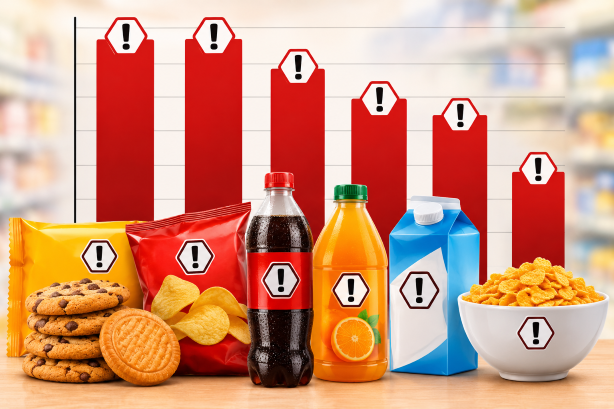
India's front-of-pack warning is now waiting on a judgement. On Monday 28 September 2026, a bench of Justice JB Pardiwala and Justice K Vinod Chandran reserved its order in 3S and Our Health Society v Union of India, the public interest case that has pushed the Food Safety and Standards Authority of India (FSSAI) towards interpretive warnings since 2024. The parties were given three days to file written submissions. As of 23 October, no judgement has been reported.
The bench made clear it was unhappy with the pace. FSSAI had proposed about four months to finalise draft regulations, followed by a 365-day period after notification during which compliance would be voluntary, according to LiveLaw's report of the hearing. Justice Pardiwala asked counsel for the regulator: "Why do you need so much time?" The bench pointed out that the exercise had begun in 2022, said any order it passed would bind FSSAI, and said it would keep the matter open for compliance reporting.
That combination, a reserved order and a bench impatient with delay, means the industry should plan for the possibility of a shorter runway than the one FSSAI asked for.
The current proposal came together quickly, under pressure from the court.
In early August, FSSAI's approach centred on showing daily recommended limits. The South First reported that an affidavit dated 3 August cited daily limits of 25 g of added sugar, 10 g of saturated fat and 5 g of salt. On 13 August, the court criticised the regulator for moving away from interpretive labelling, asked whether it was bowing to industry, and gave the Union two weeks to act.
On 28 August, FSSAI filed a six-page compliance affidavit proposing a pictorial, red, hexagonal warning on the front of the pack. According to LiveLaw, the warning text would be one point larger than the font in the back-of-pack nutrition table. The declarations would read "High Fat", "High Sugar", "High Salt" or "Highly Sweetened Beverage". Single-ingredient foods and foods inherently rich in fat, sugar or salt, with ghee, edible oil, salt, sugar, jaggery and honey given as examples, would be exempt and remain under other labelling rules. The affidavit proposed two phases: first products high in two or more nutrients of concern plus certain sweetened beverages, then products high in any one.
On 10 September, the court issued an order putting 13 questions to FSSAI, covering thresholds, the treatment of ultra-processed foods, the choice of added rather than total sugar, trans fat, the size and colour of the hexagon, and whether separate symbols should be used for each nutrient. At that hearing, FSSAI's counsel, Additional Solicitor General Brijender Chahar, accepted a single-phase approach: a product high in any one nutrient of concern would carry the warning.
On 28 September, the bench heard the parties on that revised proposal and reserved its order.
The numbers are what matter in the factory. Business Standard reported the limits proposed in FSSAI's 28 August affidavit, which draws on the ICMR-National Institute of Nutrition's Dietary Guidelines for Indians, 2024:
|
Basis |
Added sugar |
Added fat |
Salt |
Energy |
|
Solids, per 100 g |
3 g |
4.2 g |
625 mg |
250 kcal |
|
Liquids, per 100 ml |
2 g |
1.5 g |
175 mg |
70 kcal |
Source: Business Standard, 11 September 2026, reporting FSSAI's 28 August affidavit.
Three caveats apply. First, these are proposed figures, and the court has questioned whether a single uniform threshold should apply across food categories. Business Standard reported that the bench suggested covering the highest-calorie category first and then extending to the next with progressively lower thresholds. Second, the energy column's role in triggering a warning is not clear from public reporting, since the warning itself names only sugar, fat and salt. Third, LiveLaw reported that the proposal uses two tests, one per 100 g and one per serving. A senior advocate for a food processors' association argued that the ICMR guidelines work on a 100 g basis, while international practice also considers serving size. How the final rule handles serving size could move many products across the line in either direction.
There is also the question of what "added" means. The petitioner has argued for total sugar and saturated fat, citing a 2021 FSSAI stakeholder consensus. ThePrint reported that consumer groups, including the NAPi coalition of 29 organisations, warned that "no added sugar" products sweetened with jaggery or fruit juice concentrate could escape a warning on an added-sugar test.
We set out to apply these thresholds to a basket of 40 to 60 best-selling Indian SKUs using their declared nutrition tables. We have not done so. Too few declared panels could be retrieved and verified in time. Also, the basis that will finally apply (per 100 g, per serving, added or total) is still before the court. A basket built on assumptions the verdict could overturn would mislead more than it informs. We will publish a verified basket against the final thresholds once the order is out.
What we can show is what independent research says about how exposed Indian packaged food is to warning-style thresholds in general.
The most detailed public test of Indian packaged foods against a warning-label model uses the WHO South-East Asia Region (SEARO) nutrient profile model, not FSSAI's proposal. The two are not the same. SEARO uses category-specific limits, often on total sugar and total fat, while FSSAI proposes uniform limits on added sugar and added fat. The figures below should be read as an indicator of exposure, not a prediction of who will carry the hexagon.
Researchers from the All India Institute of Medical Sciences and the University of North Carolina tested products from the Mintel Global New Products Database sold in India between 2015 and 2020 against the SEARO model. Their study was published in Nutrients in 2021 by Pandav and colleagues. Of the products with enough nutrient data, 68 per cent would have carried at least one "high in" warning. By category:
That spread is the shape of the problem. Biscuits and namkeen are effectively all exposed under a strict model. Breakfast cereals are a split category, with real room for reformulation to make a difference.
Biscuits and bakery. Under the proposed solid-food limits, a biscuit would need less than 3 g of added sugar and less than 4.2 g of added fat per 100 g to avoid a warning. For a category built on sugar and shortening, that is not a tweak. Under a one-nutrient trigger, most sweet biscuits would carry at least "High Sugar", and many also "High Fat". Britannia has already reported moving in that direction. Agro & Food Processing reported a portfolio-wide reduction of about 3.5 per cent in sugar and 12.23 per cent in sodium in FY2025-26 against an FY2018-19 baseline. Those are meaningful cuts, but far smaller than what the proposed thresholds would require. For most biscuit makers the realistic aim is fewer warnings per pack and a lower-sugar line alongside the core, not a clean front panel across the range.
Namkeen and savoury snacks. Salt is the constraint here: 625 mg per 100 g for solids. Fried snacks also carry added fat well above 4.2 g per 100 g. The industry's sharpest argument came from Senior Advocate Devadatt Kamat, who told the court that a product like Kurkure should carry a stronger warning than salted cashews, according to LiveLaw. The point is that a uniform threshold does not separate ultra-processed snacks from nutritious ones. The court has asked FSSAI whether processing groups B and C from the 2024 guidelines should be treated differently. Snack makers should prepare for warnings on most core lines and watch closely whether the final rule distinguishes nuts and roasted pulses from extruded snacks.
Beverages. The liquid limit of 2 g of added sugar per 100 ml works out to 5 g in a 250 ml serving. Regular sugar-sweetened soft drinks would sit well above that, and the "Highly Sweetened Beverage" declaration in the original affidavit points to how FSSAI views the category. The shift is already under way. Agro & Food Processing reported that zero and low-sugar drinks now make up about 30 to 35 per cent of India's soft drinks market, up from about 5 per cent in 2020. But there is a catch for anyone swapping sugar for intense sweeteners: the proposal includes a separate front-of-pack statement, "CONTAIN NON CALORIC SWEETENER", for products containing them. Reformulation removes one label and adds another.
Breakfast cereals. This is where reformulation can most clearly change the outcome. The SEARO data show only about a third of cereals tripping a threshold, which suggests plain flakes, oats and muesli without added sugar can clear the bar. Sugar-coated and chocolate variants cannot under a 3 g added-sugar limit. Expect brands to split their ranges more sharply between plain and indulgent SKUs and to market the plain ones harder.
Dairy drinks. Flavoured milk, lassi and milkshakes would be measured against the liquid limits: 2 g of added sugar and 1.5 g of added fat per 100 ml. Sweetened flavoured milks are likely to need a warning unless sugar is cut sharply. Plain milk and unsweetened curd-based drinks should be unaffected because their sugar and fat are not added. The petitioner's push for total rather than added sugar is the variable to watch: if the court adopts it, dairy's natural lactose would count.
Exempt staples. Ghee, edible oil, salt, sugar, jaggery and honey are exempt as single-ingredient or inherently rich foods. That protects commodity packers, but it creates an odd shelf. A packet of sugar carries no warning, while a lightly sweetened cereal next to it might.
For brand owners, the warning moves the decision from the label to the recipe. Saurya Bhattacharya, a partner at JSA Advocates and Solicitors, noted in Agro & Food Processing that reformulation can involve changing suppliers, contracts and capital spending. He said this is a sensitive call in fixed price-point packs such as Rs 10. The same report put reformulation timelines at six to eight months or longer to hold taste, texture, shelf life and price. Anand Ramanathan of Deloitte South Asia said companies were already accelerating salt, sugar and fat reductions across portfolios.
Markets noticed. On 28 September, the day of the final hearing, HDFC Sky reported that Nestlé India traded more than 1 per cent lower in early deals and named Britannia, ITC, Hindustan Unilever and Varun Beverages among the exposed stocks.
Industry has not opposed the warning in principle. The All India Food Processors Association, in a filing on 24 September, said it supports front-of-pack warnings but wants scientifically set thresholds. It also argued that consumers are used to linking red with the mandatory non-vegetarian mark, Free Press Journal reported. The court raised the same colour concern itself on 10 September. The final colour is genuinely open.
For ingredient suppliers selling sugar reduction, salt reduction and fat replacement, the opportunity is obvious, but the rules shape it. Three points stand out from the record so far.
First, intense sweeteners carry their own front-of-pack statement, which favours solutions that cut sugar without relying on them.
Second, the court has asked whether reducing sugar, fat or salt could lead manufacturers to use more preservatives and emulsifiers. Reformulation that swaps one consumer concern for another may draw scrutiny later.
Third, the per 100 g versus per serving question decides how much reduction is needed. Suppliers advising brands should model both.
Audit every SKU's declared values per 100 g and per serving against the proposed solid and liquid limits. Run them under a one-nutrient trigger, since that is FSSAI's current position. Separate added from total sugar and fat in your data, because the court may yet change that basis. Flag products that use non-caloric sweeteners. And plan artwork on the assumption that the voluntary year may be shortened, because the bench told the regulator plainly it did not see why it was needed.
CHART / GRAPHIC BRIEF
Title: How exposed is Indian packaged food? Share of products exceeding at least one WHO SEARO "high in" threshold, by category
Type: bar
Data:
|
Category (SEARO model) |
Share exceeding at least one threshold |
|
Cakes, sweet biscuits, pastries |
100% |
|
Savoury snacks (potato, cereal, starch-based) |
100% |
|
Water-based flavoured drinks |
88.2% |
|
Juices |
76.5% |
|
Milk and dairy-based drinks |
74.1% |
|
Cereals (incl. breakfast cereals) |
37.4% |
Source: Pandav C et al., "The WHO South-East Asia Region Nutrient Profile Model Is Quite Appropriate for India", Nutrients 2021; Mintel GNPD products sold in India 2015 to 2020. SEARO model, not FSSAI's proposed thresholds. Label on chart: "WHO SEARO model, not FSSAI's proposal".


