
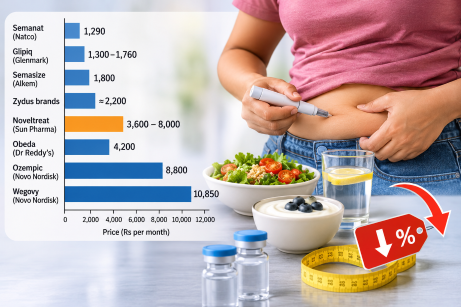
On 20 March 2026, Novo Nordisk's semaglutide patent expired in India. The next day, according to ThePrint, Dr Reddy's, Sun Pharma, Glenmark, Alkem, Zydus, Natco and Eris launched their own versions. The prices reset the market. Glenmark's vial version started at Rs 1,300 to 1,760 a month and Natco's vial from Rs 1,290 a month, against starting-dose prices of Rs 8,800 for Novo's Ozempic and Rs 10,850 for Wegovy. Ten days later, Novo cut the starting-dose price of Ozempic by 36 per cent and Wegovy by 48 per cent, Business Today reported.
The number of players depends on who is counting. Reports in March spoke of 40 or more companies and 50-plus brands. A tracking exercise by QYOBO, reported by PharmaSource in April, counted 13 companies with confirmed launches, including Novo itself.
Whatever the count, the effect on access was immediate. GLP-1 therapy in India moved from a luxury to something a salaried urban patient could plausibly pay for each month. That is the food industry's interest. A patient on semaglutide eats less, often much less, and what they do eat matters more.
Demand did not climb in a straight line, though. Pharmarack data cited by Bloomberg and reported by NutraIngredients showed monthly GLP-1 drug sales growth in India slowing from 58.4 per cent in April to 12.1 per cent in May and 2.3 per cent in June. In August, Novo Nordisk India estimated that about 250,000 people were on GLP-1 medicines, roughly 0.1 per cent of the estimated 250 million Indians living with obesity, according to Food Ingredients First. The patient base is growing, but it is still small. Any food brand building for it is betting on where the market goes, not where it is.
Doctors have started to put this in writing. In July, a panel of 13 Indian endocrinologists and diabetologists published what The South First described as India's first nutrition consensus for GLP-1-based therapies, in the journal Obesity Pillars. The panel, which included Shashank Joshi, Anoop Misra, Ambrish Mithal and V Mohan, agreed 43 of 44 statements through a modified Delphi process. Abbott Nutrition International, India, supported the work, which readers should weigh.
The consensus recommends prioritising protein quality and quantity to preserve lean mass; increasing fibre gradually; monitoring vitamin D, vitamin B12, iron and folic acid; four to five smaller meals a day; at least 2 litres of fluid; and resistance exercise alongside diet. It allows diabetes-specific formulas as partial or total meal replacements, but only under medical supervision.
The numbers behind those recommendations explain the commercial interest. The South First's summary of the consensus says GLP-1-based therapies reduce calorie intake by roughly 16 to 39 per cent. About a fifth of patients develop nutritional deficiencies in the first year, and around a quarter of weight lost may be lean mass. Patients who stop treatment without nutrition and lifestyle support may regain about two-thirds of the lost weight within a year.
Put simply, the patient needs more protein, fibre and micronutrients in less food. That brief fits the protein, fortification and medical nutrition businesses closely.
Consumer research suggests the patient's plate is changing in specific, measurable ways. IFF's report "Inside the India GLP-1 Consumer Journey", covering users in Delhi, Mumbai and Bengaluru and reported by Food Ingredients First in August, describes portions shrinking sharply: from three or four chapatis to one or two, from five or six idlis to two, and from two and a half bowls of rice to half a bowl.
The same research found that 90 per cent of users noticed a change in how food tastes or feels. Half preferred soft, easy-to-digest textures, and 74 per cent said they now read labels more carefully, looking at protein and ingredients rather than just calories. Three-quarters treated hydration as a daily goal, and 69 per cent said coconut water was part of that.
But the household basket did not change much. According to IFF, 78 per cent still bought cookies for the household, 71 per cent bought packaged sweets and full-fat dairy, and 63 per cent bought fried snacks. Harsch Koshti, IFF's regional marketing director for taste in Greater Asia, said a change in appetite "can lead to a broader change in the relationship people have with food."
For formulators, the implication is that the patient is one eater in a family kitchen. A product that only works for the person on the injection competes for a small slice of a shared grocery budget.
There is a second reason the food industry is watching: what happens to the grocery bill. Writing for the Observer Research Foundation in May, Shoba Suri, a senior fellow in its health initiative, cited a 2023 analysis that found people on weight-loss drugs bought fewer processed and sugary foods. It reported their grocery bills falling by 5 to 8 per cent, with less eating out. That analysis was not of Indian shoppers, and Indian eating differs: Suri noted that traditional diets are built around grains, vegetables and shared family meals rather than oversized individual portions.
Her piece also sets out the scale of what is at stake. GLP-1 sales in India had crossed Rs 1,000 crore since Wegovy and Mounjaro launched in 2025, she wrote, and analysts expect the market to reach US$1 billion by 2030 as adoption spreads to tier 2 and tier 3 cities. Insurance does not cover these drugs in India, so every rupee spent on therapy comes out of the same household budget as the groceries. Suri also noted that partnerships between drug and food companies tailored to semaglutide users were being explored in India. That is a direct pointer to the JV model that reached the shelf first.
Not everyone sees the drugs as the answer. Suri's article records the criticism that relying on pharmaceuticals to reshape eating ignores sedentary lifestyles, ultra-processed food and unequal access to nutrition. For food companies, that debate matters. It means the "GLP-1 friendly" pitch will be judged by public health voices as well as by patients.
So what can that patient actually buy today that is positioned for them? We looked for every India launch since March 2026 explicitly positioned as a GLP-1 companion food or supplement, using company announcements, trade press and regulatory notices. The answer is short.
Shelf one: the flagship, and its notice. On 8 May 2026, Dr Reddy's and Nestlé Health Science's joint venture announced Celevida GLP+, a nutrition product for people on GLP-1 and GIP therapy for type 2 diabetes and obesity. According to UNI's report of the launch, it contains 48 g of protein per 100 g from whey protein isolate, with branched-chain amino acids that the company said provide 100 per cent of the recommended daily allowance. It also carries 27 essential nutrients, including vitamins A and D and calcium. It comes in a 350 g pack sold through pharmacies, retail and e-commerce. M.V. Ramana, CEO of Global Generics at Dr Reddy's and a director of the JV, said that as body composition changes, maintaining lean body mass becomes critical. The JV already sells Celevida for diabetes nutrition, so this was an extension of an existing medical nutrition franchise, not a cold start.
Five months later, the regulator stepped in. On 8 October, FSSAI issued show-cause notices to Dr Reddy's, Nestlé Health Science, Tirupati Wellness and the platforms Amazon, Flipkart and Netmeds over the product's claims, according to StartupTalky and Agro & Food Processing. The objections, as reported, show where FSSAI is drawing the line:
The reports cite the Food Safety and Standards Act, 2006. No company response had been reported in the coverage we retrieved.
Shelf two: the white-label pitch. Behind the consumer brands, contract manufacturers are already selling GLP-1 ranges to anyone who wants one. Aetos Wellness, an Indian manufacturer, markets a "GLP-1 Companion Stack" on its website: a whey protein powder with HMB and prebiotic fibre, a multivitamin with B12, D3, iron, calcium and zinc, a 12-strain probiotic, sachets and bars. Its claims language includes protein to "help maintain lean muscle during rapid weight loss" and a probiotic positioned against GI side effects. The site cites "FSSAI & GMP facility" but gives no product-level claim approvals. After the Celevida notice, a brand that put that language on an Indian label would be taking an obvious risk.
Shelf three: the brands that are still deciding. Others are publicly sizing up the space without launching yet. Vijayaraghavan Venugopal, co-founder of sports nutrition brand Fast&Up, told the Growth Asia Summit in Singapore in July that the GLP-1 market in India was still evolving. He described three target groups: current users, people who have come off the drugs, and "GLP-1 adjacent" consumers who want similar benefits without medication. NutraIngredients reported that GLP-1 users already make up about a fifth of India's active nutrition consumers, without naming the source of that estimate. Venture investor Fireside Ventures wrote in June about demand for "protein-forward, protocol-led nutrition" but named no products.
The count. NUFFOODS Spectrum Asia compiled launches from company announcements, trade press and regulatory notices between March and October 2026. We found one consumer product launched in India with explicit GLP-1 positioning: Celevida GLP+. We found one manufacturer openly marketing a white-label GLP-1 range, and several brands publicly assessing the category. This is a floor, not a census. Smaller D2C listings on marketplaces may exist that our search did not surface. But the absence of a crowd of named launches is itself the finding.
The Celevida notice turns a vague question into a practical one: what can a food company say to a GLP-1 patient?
Based on FSSAI's reported objections, four kinds of claim are risky. The first is any reference to a drug or drug class on the label or in the name. The second is claims of preserving muscle or lean mass during weight loss or therapy. The third is "complete nutrition" language that implies a meal replacement. The fourth is "100%" style claims. A disclaimer does not appear to fix a misleading overall presentation.
What remains is more modest, but still saleable: declaring protein, fibre and micronutrient content accurately, offering smaller and denser portions, and letting doctors and dietitians, not the label, make the link to therapy. Medical nutrition products sold through clinicians operate in a different commercial setting from supermarket shelves. That may be why a pharma-backed JV moved first.
Accuracy is a separate problem from claims. Ashwin Bhadri, founder and CEO of the testing company Equinox Labs, told Nutrition Insight in March that protein products his lab had tested fell 20 to 40 per cent short of their label claims. He also said fortification listed on labels was sometimes absent from the product. For a patient eating a third less food, a protein shake that underdelivers is not a marginal issue. It may be a large share of the day's protein.
The evidence points to a set of opportunities that do not need a GLP-1 claim on the pack.
Protein density in familiar formats. If a patient eats two idlis instead of six, the protein has to sit in the two. Fortified batters, protein-enriched atta and dal-based ready meals fit Indian eating habits better than imported shake formats. The IFF data on smaller portions makes this case directly.
Texture and tolerance. Half of IFF's respondents wanted soft, easy-to-digest food. Gentle cooking methods appear in the clinical consensus too. This favours soups, khichdi-style meals, curd-based products and soft-baked formats over fried snacks.
Fibre, introduced gently. The consensus recommends raising fibre gradually, which argues for modest, well-tolerated fibre additions rather than high-dose fibre supplements.
Hydration. With three-quarters of users treating hydration as a daily goal, electrolyte drinks and coconut water sit comfortably in the patient's routine without any drug-linked claims.
The household, not the patient. IFF's finding that most users still buy cookies and fried snacks for the family is a reminder that "better-for-you" versions of household staples may reach more GLP-1 patients than a dedicated product would.
Three things will shape the category over the coming year. The first is FSSAI's final action on the Celevida notices, which will set the template for every brand watching. The second is whether the patient base keeps growing after the mid-year slowdown. The third is whether Indian clinical guidance hardens into specific targets for protein and fibre that brands can cite without making disease claims.
For now, India's GLP-1 patients are eating less, reading more labels and still shopping for their families. The industry that feeds them has learned one lesson quickly: in India, a product can be designed for someone on a prescription, but its label cannot say so.
CHART / GRAPHIC BRIEF
Title: Generic semaglutide: monthly price at launch, March 2026
Type: bar (horizontal, low and high of quoted range where given)
Data:
|
Brand (company) |
Monthly price at launch (Rs) |
|
Semanat (Natco), vial |
from 1,290 |
|
Glipiq (Glenmark), vial |
1,300 to 1,760 |
|
Semasize (Alkem) |
1,800 |
|
Zydus brands |
about 2,200 (average) |
|
Noveltreat (Sun Pharma), weight management |
3,600 to 8,000 |
|
Obeda (Dr Reddy's) |
4,200 |
|
Ozempic (Novo Nordisk), starting dose, before cut |
8,800 |
|
Wegovy (Novo Nordisk), starting dose, before cut |
10,850 |
Source: ThePrint, 21 March 2026; Novo Nordisk later cut starting-dose prices by 36% (Ozempic) and 48% (Wegovy), per Business Today, 31 March 2026.


