
In the second week of August 2026, food safety officers from Maharashtra's Food and Drug Administration walked into a Blink Commerce dark store in Malad West, a suburb in north Mumbai. According to the inspection details reported by IANS on 14 August, the store scored 40 out of 74 on the FDA's checklist. One chiller was running at 6°C. Medical examination records for the people handling food were missing.
NUFFOODS Spectrum Asia asked for a dark-store visit and did not get one in time for this piece, so the Malad West inspection is the closest public view inside a working store. It is worth reading slowly, because almost every problem on the inspector's sheet maps onto a design choice made far upstream: by the platform that sizes the store, by the brand that decides how big a pack should be and how long it should last, and by the regulator still working out which rules apply to a warehouse that behaves like a shop.
Malad West was not alone. It was one of 86 establishments storing and delivering food for online platforms that the Maharashtra FDA inspected in a single statewide drive. The result, as IANS and Inc42 reported it: 14 licences suspended, 60 improvement notices, and one establishment ordered to stop operations. Five of the suspended licences were linked to Blinkit, five to Zepto and two to Swiggy Instamart, with the remaining two held by other operators.
To see why one chiller at 6°C matters, start with the numbers the platforms publish.
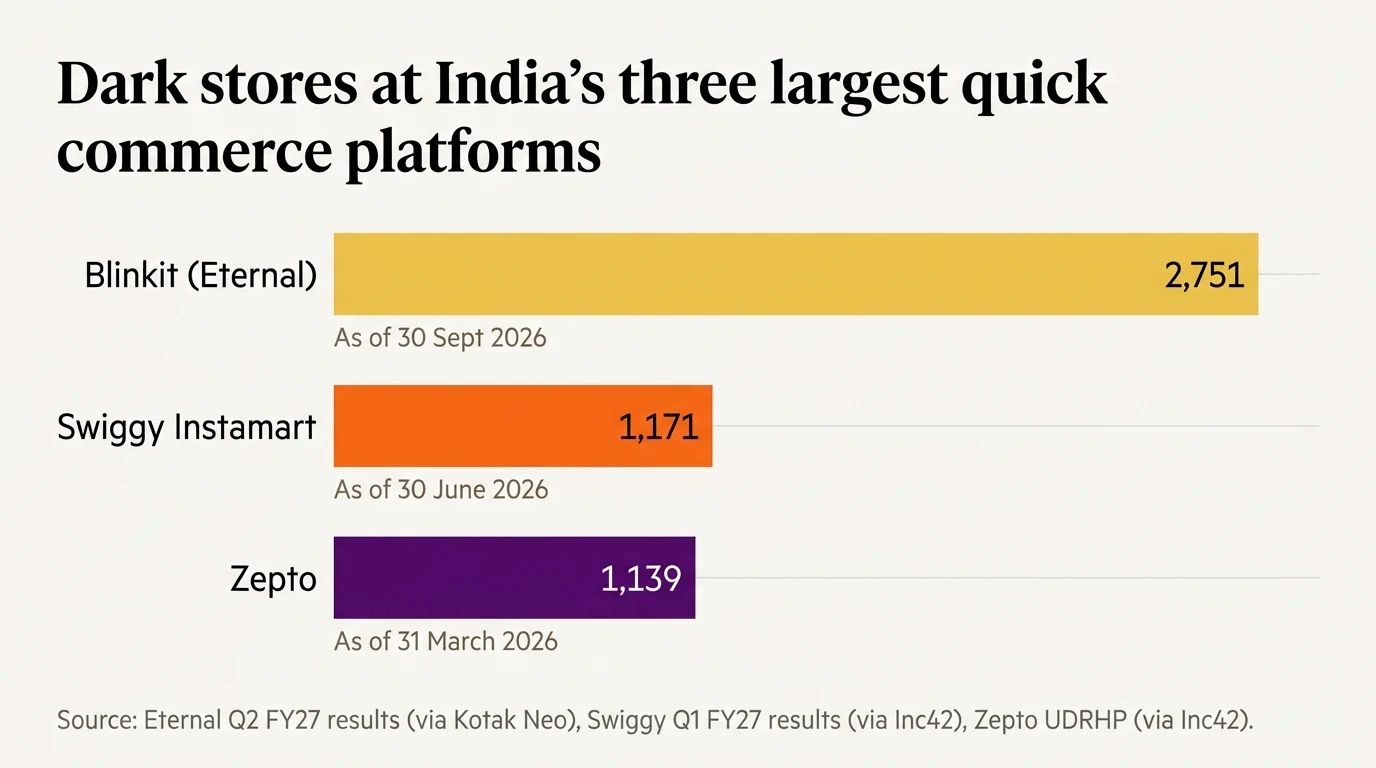
Eternal, Blinkit's parent, reported its September quarter results on 21 October. Blinkit's net order value was ₹20,940 crore, up 79.3 per cent year on year, and it added 308 stores in the quarter to reach 2,751, according to the company's figures as reported by Kotak Neo. Eternal said it expects more than 3,500 stores by March 2027 and about 5,000 by March 2028.
Its rivals are smaller but not small. Zepto's updated draft red herring prospectus, filed in June 2026, showed 1,139 dark stores at the end of March 2026, up from 1,029 a year earlier, with operating revenue of ₹22,623.6 crore and a net loss of ₹5,905 crore for FY26, Inc42 reported. Swiggy Instamart ended the June quarter with 1,171 stores in 131 cities and gross order value of ₹7,907 crore, and said it reached contribution breakeven in May 2026.
Count only those three platforms and India has more than 5,000 dark stores. Each one is a compact building. An HDFC Securities report, summarised by HDFC Sky in September 2026, put a typical dark store at about 4,000 square feet carrying around 15,000 SKUs, against roughly 600 SKUs in a 200 square foot kirana. The same report estimated an average order of about ₹650 at a dark store against about ₹65 at a kirana.
That is a lot of product, in a small space, turning fast. Fifteen thousand SKUs in 4,000 square feet leaves little slack for the segregation, ante-rooms and separate expiry zones that food safety rules assume.
For packaged food companies, quick commerce has stopped being an experiment. In a report published on 27 May 2026, The Economic Times found that 10-minute platforms accounted for 60 to 75 per cent of online sales at ITC, AWL Agri Business, Tata Consumer Products and Parle Products in FY26, up from under half a year earlier. Parle put its figure at 65 per cent against 50 per cent in FY25. AWL Agri Business reported 65 per cent against 45 per cent. Dabur said quick commerce made up 75 per cent of its online sales in the March quarter, and Britannia's chief commercial officer said its share was above 70 per cent and expected it to reach 85 per cent.
Hindustan Unilever has gone further in how it organises for the channel. Chief executive Priya Nair told analysts in February that quick commerce was 3 per cent of HUL's business but growing almost 100 per cent quarter on quarter, and that the company had set up a separate quick commerce organisation reporting directly to the head of sales, with its own supply chain, forecasting and data integration.
The HDFC Securities work adds context: for listed FMCG companies, e-commerce now makes up 8 to 15 per cent of domestic revenue, and 50 to 70 per cent of that comes through quick commerce. Nestlé India's e-commerce share rose from 1 per cent in FY18 to 15 per cent in FY26, by HDFC's estimate.
So what does a product built for this channel look like? The public evidence on food is thinner than the hype, and that is itself a finding.
The clearest published data on pack architecture comes from beauty and personal care rather than food. A Redseer analysis published in August 2026 found that products selling in 500 ml or one-litre packs in general trade tend to do better in 100 to 200 ml packs on quick commerce, because shoppers use 10-minute delivery to top up rather than stock up. It advised brands to build distinct SKUs, smaller sizes and price points suited to the channel.
On the food side, the HDFC Securities report said FMCG companies will need smaller packs suited to quick commerce, and noted that Britannia's high share of low-unit packs in biscuits had affected its uptake in modern retail. Earlier reporting by YourStory on smaller packs named food and beverage brands such as Epigamia, The Whole Truth, Snackible, Slurrp Farm and GO DESi using smaller formats to drive trial, though not specifically for quick commerce.
What NUFFOODS Spectrum Asia could not find in any retrieved filing or earnings call was a food company putting a number on how many quick commerce exclusive SKUs it runs, or how it has changed shelf life to suit the channel. That gap matters, because shelf life is where the dark store and the factory meet.
Every platform that holds inventory carries the cost of what expires. Blinkit disclosed in its June quarter shareholder letter that inventory losses, covering expired stock, damaged goods, items lost in movement and theft, ran at about 1.8 per cent of net order value. Apparel Resources applied that rate to the quarter's ₹17,132 crore of net order value and estimated the loss at about ₹308 crore, roughly three times Blinkit's adjusted EBITDA of ₹102 crore for the same quarter. That figure is the publication's calculation, not one Blinkit reported, but the 1.8 per cent rate is Blinkit's own.
The loss is not only financial. When the Maharashtra FDA went through stores in August, inspectors at an Andheri West site found an expired pack of Zorabian chicken curry cut, with an expiry date of 12 August 2026, and discarded it, according to the IANS report. In Pune, products were being held past their use-by dates. At Andheri West and in Pune, inspectors recorded failures to follow first-in, first-out or first-expired, first-out stock rotation.
Brands should take note of where that leaves them. For years, quick commerce platforms and consumers have argued over whether near-expiry stock is being pushed into the channel. The All India Consumer Products Distributors Federation, which represents traditional distributors, called the platforms a dumping ground for near-expiry stock in 2024, MediaNama reported. Some coverage has cited an FSSAI rule requiring 30 per cent or 45 days of shelf life at delivery, but NUFFOODS Spectrum Asia could not trace that rule to any FSSAI notification. MediaNama's reporting found the 30 per cent figure only in a consumer group's proposal. What FSSAI has done is advise e-commerce food businesses, in December 2024, to display minimum shelf life and expiry details.
That may soon become a hard requirement. On 13 October 2026, FSSAI chief executive Rajit Punhani said the regulator was planning to amend its rules so that consumers see the manufacturing date, expiry date and batch number of products before they order, Inc42 and Business Today reported. Punhani told Bloomberg the regulator was trying to "tighten and make them accountable." For a brand, that turns the date code from a back-of-pack detail into something every shopper sees on the listing.
Temperature is the second recurring finding. At Malad West it was the 6°C chiller. At the Zepto site in Lokhandwala, inspectors noted there was no ante-room for frozen products. At Andheri West, a product that should have been held at 0 to 4°C was stored at about 8°C.
These are not new problems. In June 2025, the Maharashtra FDA suspended the licence of a Zepto warehouse in Dharavi run by its parent Kiranakart Technologies after finding food stored beside stagnant water, mould on food items, expired products not discarded and cold storage that did not meet standards, Inc42 reported. A Zepto spokesperson said food safety and hygiene were "non-negotiable" and that the company had started an internal review. Days later, a Blinkit dark store in Pune's Balewadi lost its licence after an inspection on 5 June 2025 found it had no licence to sell food and lacked a calibration certificate for its cold storage equipment.
The pattern has spread beyond Maharashtra. On or about 11 August 2026, Karnataka's Food Safety and Drug Administration sealed a Zepto warehouse in Hoskote, near Bengaluru, operated by Nippon Express, and fined it ₹25,000, according to The Week. Officials flagged food packets and garbage on the floor, unhygienic storage and misbranding. In Telangana, a food safety task force raid on a Blinkit warehouse in June 2024 led to the seizure of ₹30,000 of expired food and ₹52,000 of foodgrains suspected of infestation, MediaNama reported.
The Hoskote case is a reminder that dark stores sit at the end of a longer chain. A brand's product can pass through a third-party logistics warehouse before it ever reaches the store, and each handover is a place where temperature can drift.
FSSAI's approach has moved from advisories to penalties. In a meeting with more than 70 e-commerce representatives in mid-2025, the regulator told platforms to print FSSAI licence numbers on invoices, list their warehouses and storage sites on its FoSCoS portal, upload facility photographs and put food handlers through FoSTaC hygiene training, MediaNama reported. Maharashtra separately said it would require state approval before new dark stores open and inspect them twice a year.
On 23 September 2026, FSSAI announced penal action against Amazon, Bigbasket, Flipkart, Swiggy Instamart and Zepto over listed products, citing misbranding, misleading claims and the sale or display of prohibited articles, Inc42 reported. In October, Punhani said e-commerce prosecutions had risen at least five to six times over the past year and that notices had gone to more than 150 food and beverage makers. He also said FSSAI would tighten dark store inspections, with particular attention to frozen goods.
Distributors want more. In August, the AICPDF wrote to FSSAI and the Union Health Ministry asking for a uniform framework for dark stores, including a minimum storage area tied to the number of SKUs a facility handles, separate zones for damaged and expired goods, and surprise inspections, the Free Press Journal reported.
For a food brand selling through these platforms, three practical conclusions follow from the public record.
First, the store is now part of your brand's food safety story. A quick commerce executive said in 2024, after a contamination complaint, that platforms cannot do much about problems that start in manufacturing. The reverse also holds: a brand cannot control a 6°C chiller, but its product is the one the shopper opens.
Second, date coding and remaining shelf life are about to become visible at the point of sale. If FSSAI's planned amendment goes through, products that arrive at dark stores with short remaining life will be easy for shoppers to spot and skip.
Third, pack design for this channel is still mostly being done without published evidence on food. The beauty data point towards smaller top-up packs. Food brands that test the same idea will want to weigh it against the extra handling, the extra SKUs crowding a 4,000 square foot store, and the inventory losses platforms already disclose.
The Malad West store may well be compliant again by the time this is read. The questions its inspection sheet raised will not go away as fast.
CHART / GRAPHIC BRIEF
Title: Dark stores at India's three largest quick commerce platforms
Type: bar
Data:
|
Platform |
Dark stores |
As of |
|
Blinkit (Eternal) |
2,751 |
30 Sept 2026 |
|
Swiggy Instamart |
1,171 |
30 June 2026 |
|
Zepto |
1,139 |
31 March 2026 |
Source: Eternal Q2 FY27 results (via Kotak Neo), Swiggy Q1 FY27 results (via Inc42), Zepto UDRHP (via Inc42). Dates differ; label each bar with its date.


